
Tensions in Iran are increasing pressure on Romania’s economy
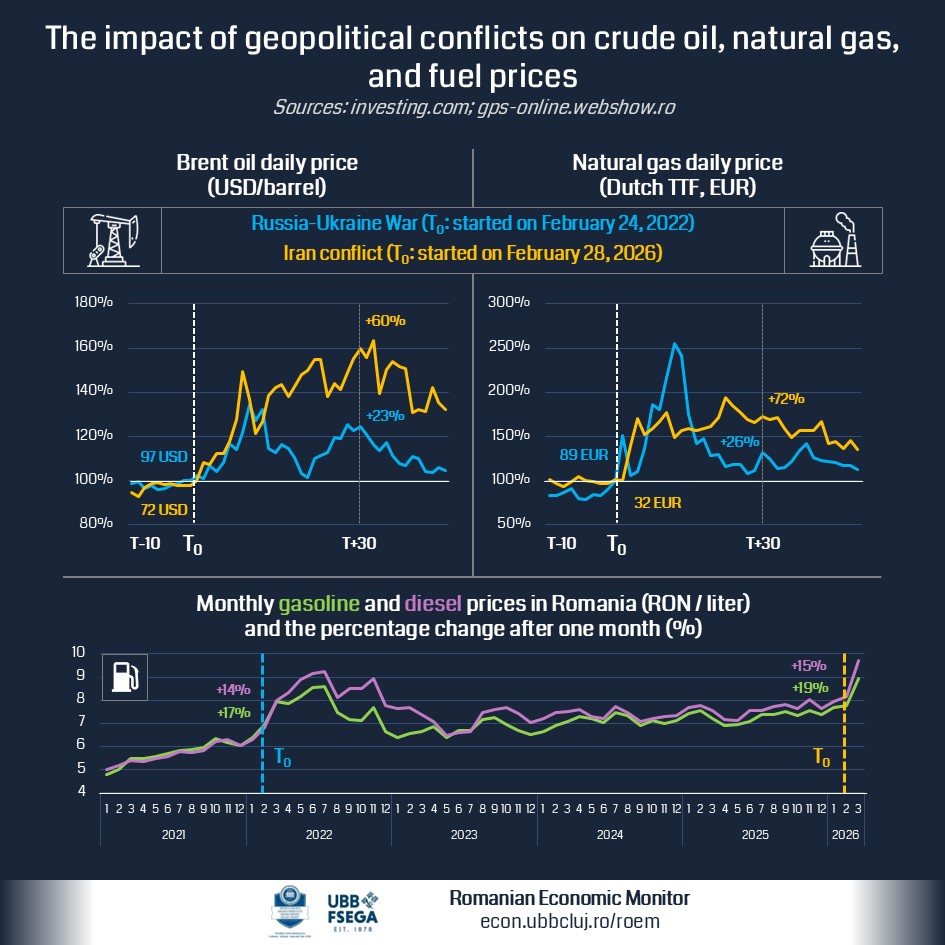
The prolonged conflict in Iran and the associated risks to global oil supplies are exerting increasingly visible pressure on European economies, including Romania. Against a backdrop of heightened volatility in energy markets, rising fuel prices have emerged as a primary channel for transmitting geopolitical shocks to the real economy.
The escalation of the war in Iran has prompted an immediate reaction from international markets, resulting in a sharp increase in the price of crude oil per barrel, as well as other energy products.
To provide a benchmark for the magnitude of the current energy crisis, a parallel must be drawn with the last comparable crisis in 2022, triggered by the onset of Russia’s invasion of Ukraine.
Thus, at the start of the Russia-Ukraine conflict on February 23, 2022, the price of Brent crude oil was $96.84 per barrel, reaching $119.03 per barrel a month later—an increase of 22.91%. During the same period, the TTF natural gas price rose from 88.89 euros/MWh to 111.61 euros/MWh (+25.55%). By comparison, during the U.S./Israel-Iran conflict, the price increase was significantly more pronounced. The price of Brent crude rose from 72.48 USD/barrel on February 28, 2026, to 115.86 USD/barrel one month later (+59.85%), while the TTF natural gas price advanced from 31.96 EUR/MWh to 54.81 EUR/MWh, marking an increase of 71.50%.
It should also be noted that in 2022, the natural gas price crisis only intensified several months later, at the beginning of the autumn season; a similar scenario could unfold this year if the Iranian conflict escalates and extends into the autumn.
It is important to emphasize that the disruption caused by the closure of the Strait of Hormuz is approximately 15 to 20 times greater than the supply impact observed during the initial months of the war in Ukraine, rendering it a significantly more direct threat to global oil availability.
Furthermore, in 2022, the Romanian government benefited from greater fiscal maneuverability for interventions and subsidies, given that the state budget had already entered a consolidation phase following the pandemic, with a deficit of 6.7% of GDP in 2021; by contrast, 2025 concluded with a higher deficit of 7.6%.
Analyzing the impact of these phenomena on the evolution of the Romanian economy, we have identified three primary channels through which the Middle East conflict may negatively influence Romania’s economic growth.
- High inflation.Although the country benefits from a degree of energy independence compared to other states in the region, domestic prices remain aligned with international market dynamics. Consequently, the rise in oil prices rapidly translates into higher transport, production, and logistics costs, undermining corporate competitiveness and household budgets. These tightened budgets exert additional pressure on consumption, which is already declining compared to the previous year, thereby limiting the country’s economic growth.
- Reduced exports. Elevated oil prices, coupled with global geopolitical uncertainties, are negatively impacting economic growth within the Eurozone—a region that serves as the primary destination for Romanian exports. The negative economic outlook for countries in this region has a direct impact on Romanian exporters, and a potential reduction in exports directly hinders the country’s GDP growth.
- Economic uncertainties. In the current geopolitical and economic climate, characterized by significant uncertainty, companies are opting to postpone scheduled investments to maintain flexibility and prepare for unforeseen economic scenarios. The population also prefers to save by postponing or reducing investments and overall consumption. Regarding the state budget, investors are becoming more cautious in the face of these risks, which may contribute to an increase in the cost of financing sovereign debt. All these factors worsen the outlook for the Romanian economy in 2026.
Considering these channels of influence, our team estimates that every 10% increase in the price of a Brent crude barrel can add approximately 0.3 percentage points to Romania’s annual inflation rate.
At the same time, the rise in oil prices can slow economic growth through three primary mechanisms. The first is direct: the erosion of purchasing power resulting from price increases leads to diminished consumption and, consequently, a tempering of the economic growth rate. The remaining two channels are indirect. On one hand, the weakening of the global economy—and particularly that of the Eurozone—impacts the Romanian economy, given that these states represent Romania’s primary trading partners. On the other hand, rising economic uncertainty leads to more cautious behavior from economic agents, who may postpone or reduce significant investments. Similarly, the population tends to adjust its consumption behavior by deferring non-essential spending.
Regarding crisis mitigation measures, capping fuel prices by limiting commercial margins represents only a temporary, short-term solution intended to provide companies and households with a transition period to adapt to the new situation. In the long run, however, such interventions can generate market imbalances, including risks of product shortages, which renders them unsustainable.
The fundamental problem at present is the reduction in the quantity of available oil due to the blockages in the Strait of Hormuz, a development directly reflected in rising fuel prices. The government has already intervened to mitigate the initial shock to the fuel market through temporary measures, valid until June 30, 2026, thereby ensuring a timeframe for economic agents to adapt to the new market conditions.
At the same time, given that the structural problem cannot be managed over the medium and long term through similar interventions, the essential role of any government is to ensure that adopted policies do not exacerbate existing budgetary imbalances. In a fragile fiscal context, characterized by limited room for maneuver, the scope and sustainability of fiscal measures become critical.