
Domestic political instability and global crises are pushing Romania toward recession in 2026
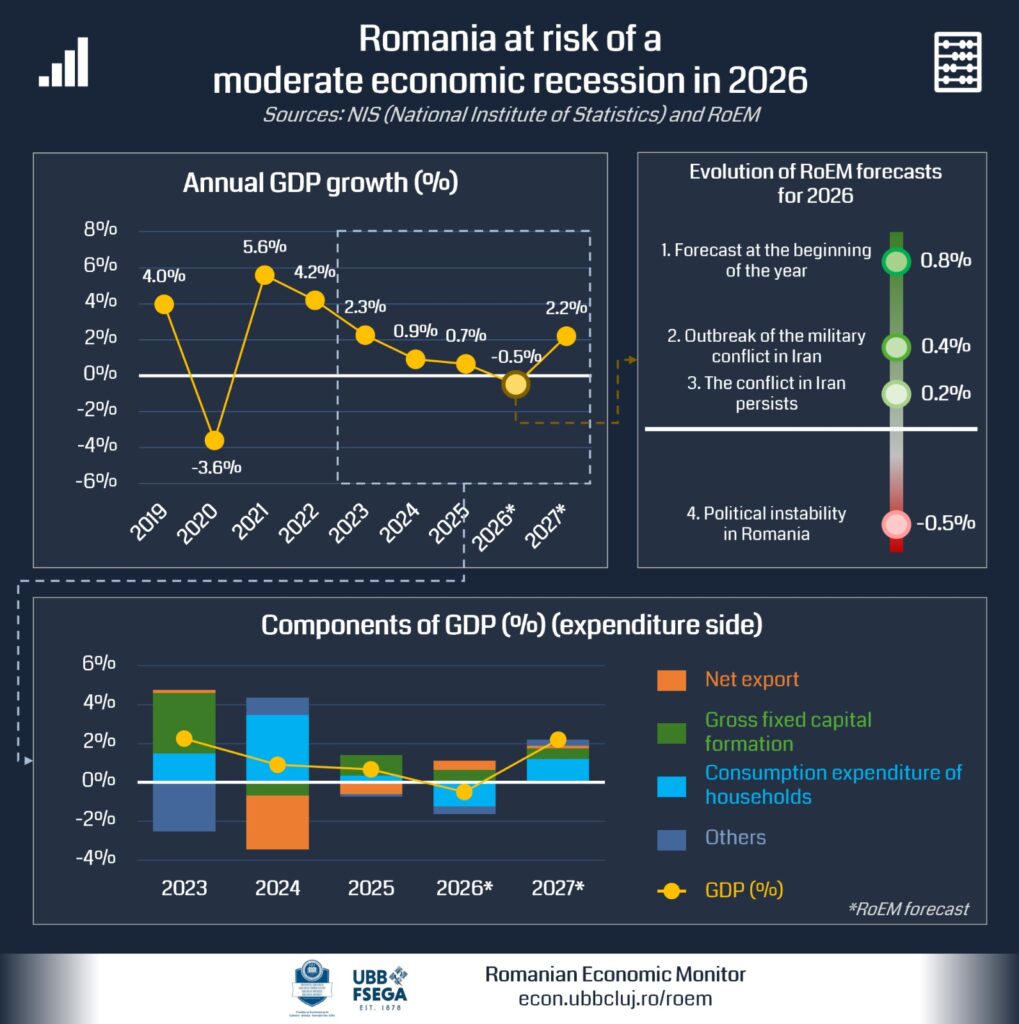
The global and European economy is going through a difficult period, in which several crises overlap, such as the war in Ukraine, the war in the Middle East, the energy crisis, inflationary pressures, etc., which taken together create major pressure on all national economies. In such a context, a country closely linked to the global economy and especially to the European one has only one option: being unable to significantly influence the global crisis, it needs the strongest possible internal stability in order to remain as resilient as possible, managing the negative effects of the multiple world crises. Precisely during this period, Romania is facing heightened political instability and polarization, culminating in the adoption of a motion of censure in Parliament, following which the Government led by Ilie Bolojan was ousted on 5 May 2026. In such scenarios, political uncertainty does not remain merely a problem of the political class, but is rapidly transferred to the economy through declining investor confidence, the postponement of investment decisions, volatility in financial markets, and additional difficulties in managing the budget deficit and the necessary reforms.
The first signal in this regard came immediately after the announcement of the intention to file the motion of censure, through the significant increase in the euro exchange rate, which in just a few days reached a historic high of 5.27 lei. Tensions were quickly transmitted to the public debt financing market as well: the state’s financing costs increased, CDS spreads widened, indicating a higher perception of sovereign risk. The prospect of a possible downgrade of Romania’s rating to “junk” category by the rating agencies remains an immediate risk. Under such conditions, financing the deficit becomes more costly, and investor demand for government bonds may decline, which amplifies the pressures on Romania’s financial and budgetary stability. However, the effects of political instability will be persistent, ultimately reflected in a deterioration of the country’s economic performance. In this context, the Romanian Economic Monitor team is carrying out a significant revision of the forecast regarding the evolution of Romania’s GDP in 2026, anticipating for the first time this year a negative value, an economic contraction.
From a chronological perspective, at the beginning of the year our team estimated a slight economic growth of 0.8%, supported mainly by a gradual improvement of macroeconomic indicators in the second half of 2026 (the diminishing effects of austerity measures, fiscal consolidation, disinflation, the accelerated use of European funds). The first revision of the forecast came with the outbreak of the military conflict in Iran, at which point the economic growth estimate was reduced to 0.4%, and after a few weeks to 0.2%. Currently, against the backdrop of the overlap of global crises with internal political instability in Romania, the new forecast indicates a GDP decline of 0.5%, which would correspond to a moderate economic recession for 2026.
But, despite this scenario, there are nonetheless reasons for tempered optimism. In the longer term, there is potential for the stabilization of the economy: the moderation of inflation could lead to the recovery of purchasing power and domestic consumption, the effects of fiscal measures could gradually fade, and the business environment could adapt to the new economic realities. At the same time, assuming Romania consistently continues its fiscal consolidation process, investor confidence could strengthen, and public debt financing conditions could normalize. These developments could create favorable premises for relaunching economic growth. In this context, our estimate for 2027 remains positive, with the forecast indicating a growth of Romania’s GDP of 2.2%.