
The evolution of ROBOR is in line with monetary policy and inflation, with no signs of atypical developments
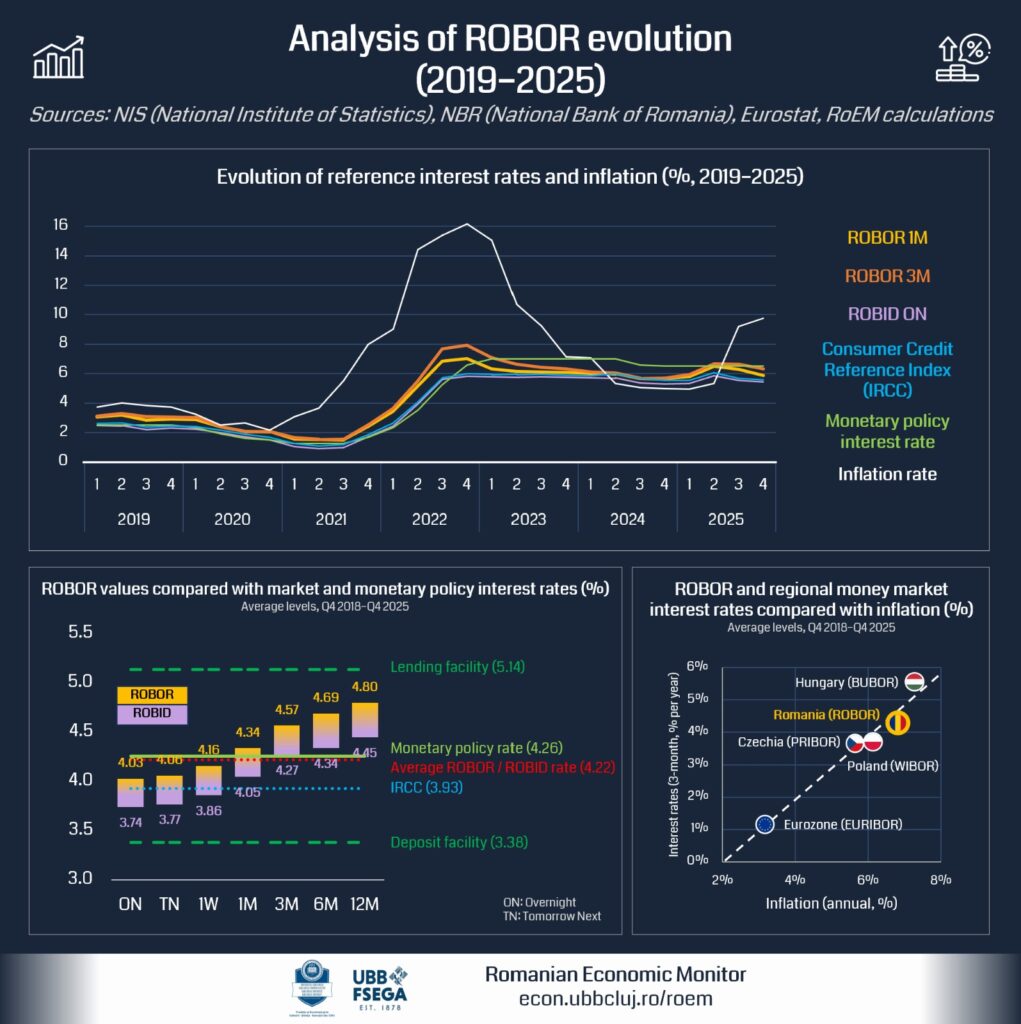
In the context of the Competition Council’s investigation into the alleged coordination of ROBOR quotations by several banks in Romania, an analysis of the index’s evolution became necessary. The team’s conclusion is that the evolution of ROBOR does not reveal significant anomalies, the level of the index being consistent with the monetary policy decisions of the National Bank of Romania (NBR) and with the dynamics of inflation.
ROBOR must be understood both as a set of rates applicable to transactions on the interbank market and as a benchmark that indicates the cost of liquidity in the economy. From this perspective, its evolution and any suspicions regarding possible manipulation must be analysed with technical rigor, from a financial and legal standpoint, avoiding simplistic interpretations or the politicization of the subject. At the same time, any arguments and evidence that the Competition Council will make public regarding the alleged manipulation of ROBOR will need to be analysed on the basis of expert considerations and criteria.
What is ROBOR?
Just as banks set interest rates for the deposits they attract and the loans they grant to clients, they charge interest for the operations carried out among themselves, namely for loans and placements on the interbank market. ROBOR (Romanian Interbank Offer Rate) does not represent a single interest rate, but rather a set of rates that differ according to the term of the financing.
In the case of the interbank market in Romania, ROBOR rates are established for several maturities: overnight (O/N – one day, starting from the day of the fixing mechanism), tomorrow next (T/N – one day, starting from the next business day), one week (1W), one month (1M), three months (3M), six months (6M) and 12 months (12M). Of particular importance is the 3-month ROBOR rate, which was used for many years as the most common benchmark for calculating interest rates on long-term mortgage loans.
Thus, ROBOR rates are not merely simple interest rates at which interbank transactions can be carried out, but also fulfil the role of a benchmark for the interbank money market. As is natural in the case of market quotations, ROBOR rates synthesize, for each maturity, relevant information about market conditions and indicate the levels at which participants are willing to transact, thereby contributing to price discovery.
Analysing the structure of ROBOR quotations, it can be observed that, as the maturity becomes longer, the volume of actual transactions decreases. This is a natural characteristic of the market, since participants generally prefer shorter maturities, which involve lower liquidity and duration risks. Even in situations where the number of actual transactions for longer maturities, such as 6 months or 12 months, is small, longer-term ROBOR quotations continue to fulfil the role of a price benchmark for the financial market.
How can the evolution of ROBOR be analysed?
ROBOR is a relevant indicator for several categories of participants in the financial market: for individuals who have loans with variable interest rates linked to this index, the evolution of ROBOR directly influences the level of the monthly payment; for banks, ROBOR represents the cost of financing on the interbank market. Beyond these, however, ROBOR is, first and foremost, a technical-financial indicator of the money market, which reflects the fundamental economic benchmarks of that market.
Like any interest rate on the money market, ROBOR cannot be analysed separately from the economic context in which it evolves. Its level mainly reflects the cost of money and is influenced by a series of factors, such as expectations regarding the evolution of the economy, the liquidity available in the market, default risks or systemic risks, as well as the domestic and international monetary and financial context. Among these factors, monetary policy and the dynamics of inflation play an essential role.
First of all, in a market economy, interbank interest rates must reflect the orientation of monetary policy, in particular the level of the monetary policy rate and of the monetary policy corridor, defined by the difference between the NBR lending interest rate and deposit interest rate. In simple terms: interbank market interest rates should, as a rule, evolve close to the levels established by the central bank.
An analysis of the evolution of ROBOR rates in the period between the fourth quarter of 2018 and the fourth quarter of 2025 — an interval that largely overlaps with the period targeted by the Competition Council’s investigation — shows that their average values over the entire analysed period fall within the monetary policy corridor, without deviations or atypical developments. Moreover, the simple average of the ROBOR and ROBID rates during this period is very close to the average level of the monetary policy rate, namely 4.22% compared with 4.26%.
Secondly, inflation over a longer period is one of the most important macroeconomic indicators that influence the evolution of interest rates. Analysing the evolution of interbank interest rates and inflation in Romania, in the countries of the region, and in the euro area, a close relationship can be observed between the two variables.
The data show that the economies of countries with higher average levels of inflation have generally also had higher average levels of interest rates, the relationship between the two being close to a one-to-one ratio. At the same time, over the course of the analysed period, interest rates were, on average, below the level of inflation. This situation is specific to a context dominated by supply shocks, which generated strong price increases not only in Romania but throughout the entire region.
The pandemic, the disruptions of global supply chains, the energy crisis and geopolitical tensions — including the war in Ukraine and the episodes of instability in the Middle East — contributed to the acceleration of inflation. To these were added Romanian fiscal measures as well, such as the increase of certain taxes and duties adopted in the context of the efforts to reduce the budget deficit.
From this perspective, the evolution of ROBOR behaved similarly to that of interbank rates in the region. The analysed data are, therefore, in line with the fundamental economic mechanisms and do not indicate atypical developments: in economies where inflation is higher, interest rates also tend to be higher.
What are the mechanisms that clearly limit the possibility of manipulating ROBOR?
ROBOR is an indicator that is difficult to influence, since its value is calculated on the basis of the arithmetic mean of the quotations submitted by ten representative banks in Romania, after the elimination of the extreme values. Through this mechanism, the impact of a single quotation on the final result is limited.
On the other hand, the ROBOR mechanism includes an additional limitation introduced by the NBR, through the establishment of a maximum spread between ROBID and ROBOR, namely between the interest rate on interbank deposits and the interest rate on interbank loans. This means that those who would intend to raise the level of ROBOR would be obliged to also raise the level of ROBID, potentially reaching a situation in which they are forced to pay higher interest rates on interbank deposits. This would entail an additional cost for the banks (with the deposits).
Another important element is the fact that the data on ROBOR quotations are centralized and calculated in an automated manner by a neutral international entity, called the calculation agent, reducing the possibility of subsequent direct manipulation of the final value by the banks.
The ROBOR case vs. the LIBOR scandal of 2012
In order to put into perspective, the importance of any potential suspicions regarding the manipulation of a reference rate, one can recall the LIBOR scandal of 2012, one of the most well-known cases of financial market manipulation at the global level.
LIBOR (London Interbank Offered Rate) was a reference rate widely used in the international financial system, being calculated on the basis of the estimates submitted by the major banks regarding the cost at which they estimated they could borrow from one another on the London interbank market. It was used as a benchmark for financial instruments with a nominal value of over 300 trillion dollars, from mortgage loans and consumer loans to derivative instruments and corporate bonds. An important characteristic of the LIBOR mechanism was the fact that it was based on the bank’s declarative quotations, and not on actual transactions carried out on the market. More specifically, the banks submitted estimates regarding the cost of financing, without the obligation to carry out real transactions at the reported levels.
The investigations carried out by the authorities in the United States, the United Kingdom and the European Union showed that several international financial institutions deliberately influenced the LIBOR quotations. According to the investigators, the traders involved deliberately manipulated the reported rates, either to maximize their profits on positions in derivative instruments or to conceal the financial difficulties of their own banks during the period of the global financial crisis of 2007-2008.
The evidence collected during the investigations included electronic correspondence, instant messages and recordings of telephone conversations between traders, who communicated openly about the manipulations carried out, using language that demonstrated that the practice was considered normal within the institutions. The case had major financial and legal consequences for the banking sector: several institutions received fines on the order of hundreds of millions or billions of dollars, the total value of the sanctions exceeding 9 billion dollars. Likewise, several traders were sentenced to prison, and the scandal even led to changes at the management level of some banks, including the resignation of Barclays’ chief executive, Bob Diamond.
From a regulatory perspective, the LIBOR scandal brought major changes in the way reference rates are established on the financial markets. LIBOR came under the supervision of the British authority, the Financial Conduct Authority (FCA), and starting in 2023 it was gradually replaced with indicators based on real transactions, such as SOFR (Secured Overnight Financing Rate) in the United States and SONIA (Sterling Overnight Index Average) in the United Kingdom. This transition marked a global trend of abandoning interbank reference rates (the offered rate type) in favour of indicators calculated on the basis of real interest rates and operations in the market. A similar change also took place in Romania, where, starting in 2019, ROBOR was replaced by the IRCC (Consumer Credit Reference Index), in the case of new loans granted to individuals.
Compared with the mechanism that formed the basis of LIBOR, ROBOR presents a series of fundamental differences, an essential element being the firm nature of the quotations submitted by each participant, representing commitments made within a set of rules established by the NBR. Consequently, the ROBOR mechanism is not based exclusively on indicative estimates, but on quotations assumed by the participants and associated with a real possibility of transacting, which differentiates it from a purely indicative benchmark such as LIBOR, where the reported quotations did not entail an obligation to carry out transactions at those levels.
Another fundamental difference concerns the nature of the available evidence regarding possible manipulation. Although there have been speculations and references to possible unofficial discussions between representatives of the banks concerning the level of ROBOR quotations, the Competition Council has not, to date, made public any concrete evidence of the alleged manipulation (telephone conversations, messages, e-mails, etc.). In this context, the statement of the President of the Competition Council is relevant, according to which there had been “numerous contacts between the staff of the banks involved,” even if the situation had not been classified as a classic cartel. The President of the Competition Council also indicated, as a possible problematic element, the fact that the banks participating in the ROBOR mechanism had access to the quotations of the other members of the consortium, which, in the opinion of the authority, could have negatively influenced competition between them. On the other hand, the banks argued that this visibility of the quotations represents a form of price transparency, similar to other markets in which participants have access to public information regarding the price levels in practice.