
Capping commercial markups : limited impact on inflation, but adverse economic effects
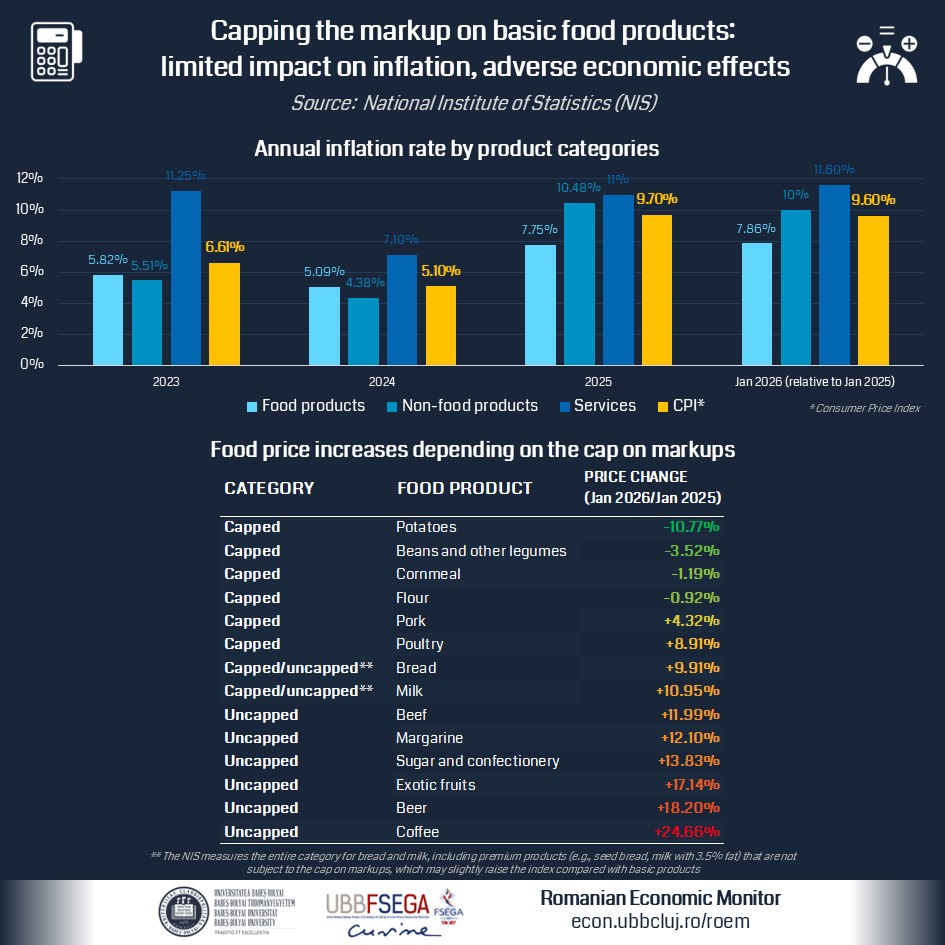
Currently, commercial markups on staple foods are capped in Romania at 20% for processors, 5% for distribution chains, and 20% for retailers, meaning that the price of basic foodstuffs in stores can be a maximum of 51.2% higher than the production cost. The aim of these measures is to curb inflation and increase real income, particularly among low-income households, where basic foodstuffs account for a significant portion of monthly expenses. Last week, the agriculture minister proposed capping markups on all agri-food products if inflation exceeds the annual rate of 5%, not just on staple foods.
The data show that food prices rose rapidly after 2023, when the aforementioned measures were introduced, by 5–6% in 2023 and 2024, accelerating to just under 8% in 2025. Thus, in the long run, capping markups failed to significantly reduce food inflation, even though prices for products with capped markups fell almost immediately in the initial phase following the introduction of the caps.
At the same time, data provided by the National Institute of Statistics (INSSE) reveal a significant divergence in consumer price trends between staple foods subject to a cap on markups (pursuant to Government Emergency Ordinance 67/2023 and subsequent extensions) and food products not subject to such a cap. Official statistics show that the products included in the regulated basket of goods have stabilized or even experienced deflationary trends on an annual basis (with price decreases for products such as potatoes, cornmeal, and flour, and moderate increases for pork). In stark contrast, food prices not subject to price caps have risen sharply, often by double-digit percentages (such as coffee, beef, sugary products, and imported fruit). Besides price caps, these price hikes were also the result of negative trends in international commodity markets, such as in coffee bean production. At the same time, this asymmetric trend also suggests a readjustment of pricing strategies by retailers, who tend to offset the profit margin restrictions imposed on staple foods by applying higher markups on unregulated products, thereby shifting inflationary pressure to the rest of the food basket.
Inflation in Romania and the EU after 2021 was driven by rising energy and raw material prices, which led to a significant increase in production costs in both the food sector and other industries. The excessive budget deficit fueled inflation by causing an unsustainable rise in domestic demand. Thus, while capping markups may provide temporary relief, it cannot address the root causes of the cost-of-living crisis—at present, inflation in Romania can only be curbed through responsible fiscal policies, supported by monetary policy. Extending the cap on markups could have significant unintended consequences, ranging from higher prices for non-food items to a higher bankruptcy rate in the food sector and even local and temporary food shortages. Thus, capping markups is a double-edged sword: while it may help socially disadvantaged households in the short term, in the medium and long term the distortions created by these measures can lead to reduced availability of basic goods and foodstuffs, high inflation for uncapped products, and economic losses in the retail sector.
The Causes and Solutions to the Cost-of-Living Crisis
The main causes of the inflationary episode following 2021 are rising energy and raw material costs, following the shock caused by the invasion of Ukraine and disruptions to global supply chains during the COVID-19 pandemic. At the same time, rising demand fueled by expansionary fiscal policies has also driven up prices.
Consequently, the surge in demand following the COVID crisis led to a short-term increase in profits and markups in some industries, reflecting both a temporary relative shortage of supply for goods such as oil and gas, and a lack of competition in the energy sector, as well as in certain industrial sectors and the construction sector.
However, Romania’s food sector comprises a large number of small producers, along with small-scale distributors and retailers—as a result, the markup primarily reflects the cost of labor and capital, rather than the market power of firms. This assertion is also supported by corroborating data from three major institutions: the degree of fragmentation and the dominance of SMEs in the food sector are confirmed by the National Institute of Statistics’ (INS) Structural Business Survey (insse.ro); the lack of market power in the production and retail sectors is highlighted in the sectoral analyses of the Competition Council (consiliulconcurentei.ro); while the transfer of operational costs (labor, utilities, capital) into the markup is consistently documented in the Inflation Reports issued by the National Bank of Romania (bnr.ro). Capping markups in the food sector could lead to losses or lower wages in retail and food companies, or to higher prices for uncapped goods (see the table). If the cap on markups is extended to multiple retail goods, and the markup limit differs significantly from the conditions dictated by the labor and capital markets, the rate of bankruptcy and closure among food and retail businesses may rise, which could lead to temporary and localized food shortages. Furthermore, capping markups can put small businesses and stores at a disadvantage compared to large companies, as they have fewer opportunities to pass on price increases to other goods and services, making these increases more noticeable in small local stores.
Furthermore, although they automatically contribute to higher inflation, temporarily high profits can have positive effects, such as stimulating production or encouraging competitors to enter the market, which can help lower prices in the long run. Capping the markup eliminates this economic incentive without addressing the root causes of inflation.
The government can reduce inflation by consistently and as fairly as possible, implementing fiscal consolidation measures to reduce the budget deficit, and the National Bank can support the disinflationary process by implementing appropriate monetary policies. Capping markups does not address the root causes of inflation—namely, the high budget deficit and rising energy and raw material costs on international markets—and therefore cannot reduce inflation or provide a solution to the cost-of-living crisis in the medium to long term.
At the same time, the cost-of-living crisis can be alleviated through fixed-amount assistance provided exclusively to low-income households. Eliminating price controls across all economic sectors and replacing them with fixed subsidies provided exclusively to those in a disadvantaged socioeconomic situation offers a more appropriate (partial) solution to the social problems caused by high inflation, while also improving market efficiency across all economic sectors.