
Energy dependence and the green transition: are there solutions to expensive and volatile energy in Romania and Europe?
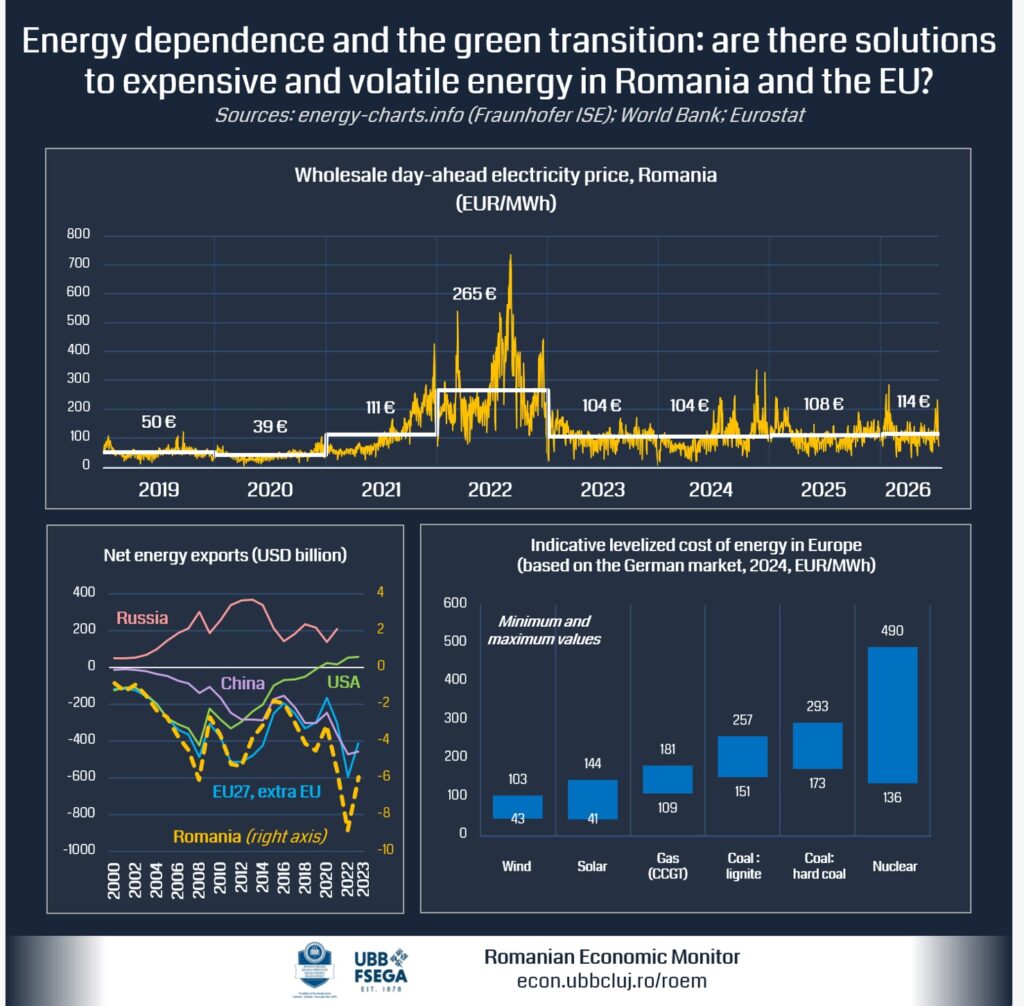
Romania and Europe have gone through several severe energy shocks, which led to a major increase in prices, thereby also reducing energy consumption. Both the level and the volatility of electricity prices on the markets in Romania and other European countries rose significantly after the pandemic. Whereas the average electricity price in Romania was 45 euros/MWh in the 2019–2020 period, in the 2021–2025 period it jumped to 136 euros/MWh, representing a tripling of the average price (!). The price of crude oil also became higher and more volatile: the average price of Brent crude rose from $53 in 2019–2020 to $80 in 2021–2025. The main reasons (together with the sudden rise in demand after the pandemic), are the reduction in Russia’s gas exports following the outbreak of the war in Ukraine and the instability in the Middle East (after 2023).
Both households and firms in Romania were profoundly affected by these shocks. In addition, the capping of energy prices increased the budget deficit through the compensations paid to energy suppliers, thereby contributing to the current budgetary crisis (even though the increase in pensions and public-sector wages contributed even more to the imbalance in the budget). And if geopolitical fragmentation deepens in the future, the volatility of energy markets and of the global economy will continue to rise.
Reducing the energy dependence of Europe, a continent with relatively limited reserves of crude oil and natural gas, can improve the economic situation – and, consequently, the political one. Increasing renewable energy capacity in Romania and the EU can represent a viable solution for ensuring the region’s energy autonomy. Although this energy transition still requires significant investments, the prices of solar and wind energy have dropped drastically over the past two decades, becoming more than competitive with energy from fossil fuels.
Geopolitical Risks and the Cost of Energy Dependence
In 2025, Romania imported approximately 5 billion euros more energy than it exported, and in the EU total energy imports exceeded exports by around 300 billion euros in the same year – significant values representing approximately 1–2% of GDP in both cases. Since energy is necessary for most economic activities, this external dependence is even more important than these values would suggest: if external supply disappears or decreases, replacing it from internal sources in the short term is extremely difficult, if not impossible. Thus, Romania’s economy is not exposed only to shocks independent of our foreign policy, such as the war between the US and Iran. Geopolitical adversaries can use the country’s energy dependence to increase their bargaining power and obtain concessions, as happened after the beginning of the war in Ukraine, when Russia’s halting of gas exports to EU countries put pressure on European governments, markets, and the public.
There is a high probability that these international crises will continue and recur in the future. Although conflicts and wars reduce international trade, the major military powers are less sensitive to energy shocks than the EU. Thanks to its significant reserves of natural gas and crude oil, Russia is a major energy exporter. The US has also become a net energy exporter thanks to the “shale revolution,” having managed to exploit its shale gas and shale oil deposits.
China is still a major energy importer. However, its significant coal reserves and the rapid growth of renewable sources may reduce its imports in the future, while Russia and Iran, important allies, ensure the crude oil flows needed by the Chinese economy. Thus, it is unlikely that the major powers would be deterred by the economic effects of triggering a conflict or war. For example, estimates by researchers at the Kiel Institute for the World Economy show that the effects of a conflict in Iran on the US economy are small, while import-dependent economies – including the European one – suffer due to high energy and agricultural product prices. Similarly, a return to importing crude oil and gas from Russia would bring Europe back into a position of strong dependence.
As after 2022, reducing energy imports from Russia diminishes its export revenues, but the effect on the energy-intensive European economies is strongly negative. For example, a group of researchers from Europe and the US estimated in 2022 that halting energy imports from Russia would reduce Germany’s GDP by 0.5–3%. Although Germany’s economy grew in 2022 and did not collapse after the reduction in energy imports, the competitiveness of its industry suffered and continues to suffer due to high and volatile energy prices. These developments negatively affect Romania’s economy, as it is closely linked to the evolution of the industries in the Euro Area, including Germany.
The Solution: The Energy Transition?
Energy autonomy can represent a solution to the problem of dependence and the volatility of energy prices. To support the competitiveness and growth of the economy of Romania and the other EU member states over the medium and long term, the cost of energy must also be reduced. The transition to renewable energy sources can represent an adequate response to both challenges. The cost of photovoltaic modules dropped by approximately 90%, from $2.44/Watt in 2010 to $0.26/Watt in 2024 (calculated in 2024 dollars), and the cost of onshore and offshore wind units dropped by approximately 50% from 2010 to 2023. Moreover, the levelized cost of electricity (LCOE) – how much, over the long term, each MWh of generated electricity costs, considering both capital costs and the cost of fuel as well as operating and maintenance costs – has become lower over time for solar and wind units compared to gas- or coal-fired plants. In Romania, the price of photovoltaic electricity, according to the 2025 contracts-for-difference auctions, is between 35.77 and 45.2 euros/MWh, which is at the lower bound of the levelized cost estimates for photovoltaic energy in Europe, while that of wind electricity is between 65.12 and 79.5 euros/MWh. The levelized cost of gas-fired plants is harder to calculate, but 2024 estimates from Germany show that it was between 109 and 181 euros/MWh, and the levelized cost of coal-fired plants was between 151 and 293 euros/MWh, that is, well above the price of renewable energy sources.
However, the LCOE does not represent the total cost of the energy system and is not equivalent to the final price paid by consumers. The indicator compares the cost of producing electricity at the level of the generation units but does not fully include the costs of the grid, storage, balancing, reserve capacity, congestion, curtailment, taxes, transmission and distribution tariffs, or the redistributive effects on households and firms. Therefore, the lower right chart on our figure must be interpreted as a comparison of production costs, not as a complete estimate of the final cost of the energy transition.
There are scientific studies showing that increasing the proportion of electricity generated by solar and wind energy reduces the wholesale price of electricity, although the effect also depends on the structure of the electricity markets. Not least, reducing major climate risks entails, over the long term, reducing emissions and expanding low-emission energy sources.
In 2024, according to the most recent Eurostat data, approximately 20% of Romania’s primary energy (which also includes oil, not just the sources used for generating electricity) came from renewable sources, compared to around 4% in 1990. Although Romania is a gas and oil producer, domestic production does not cover consumption: the country is nearly self-sufficient in natural gas but remains a significant net importer of oil. The Cernavodă nuclear power plant, whose first unit was completed in 1996, contributed to increasing energy autonomy, providing 9% of primary energy in 2024. New nuclear capacities are, in general, much more capital-intensive and have a higher levelized cost than solar or wind units. However, nuclear energy can provide low-emission capacity that is relatively stable and available independently of weather conditions, which gives it a system value different from that of variable renewable sources.
Through programs such as Casa Verde Fotovoltaice, the Government of Romania has supported the country’s energy transition. The process can, however, be facilitated and accelerated by simplifying the regulations concerning the authorization of solar and wind units. In addition, the expansion of energy grids will be essential for the transition and will entail major investments in infrastructure. At the same time, the expansion of electricity grids can reduce energy prices and stimulate private investment in renewable sources. There are several scientific studies suggesting that integrating solar energy grids in regions with intense economic activity can reduce electricity costs and drive further investment in solar energy.
Likewise, the price of lithium batteries has dropped drastically over the past decades, by 85% between 2010 and 2024, which eases energy storage and reduces the problems associated with the intermittency of some renewable sources, such as solar or wind energy, which depend on weather conditions. At the same time, the same development has also led to a decline in the price of electric vehicles. The price and performance of electric cars produced in China are already competitive with classic, internal-combustion cars. The expansion of charging infrastructure can support their adoption in Romania and, thus, the reduction of dependence on oil imports.
Storage can reduce some of the problems of intermittency, especially over short intervals, but it does not fully replace investments in grids and interconnectors. Batteries shift energy in time, while grids shift it between regions.
Even in the case of renewable energies there are geopolitical dependencies. The production of solar panels is concentrated in China, and a large part of the rare earths needed for renewable energy installations are extracted and, above all, processed in China. Furthermore, the production of components for solar modules or wind turbines still requires fossil fuels. However, unlike a system based primarily on fossil fuels, renewable energy systems do not require continuous fuel inputs and are thus more resilient to external shocks. Moreover, recycling batteries and solar panel components can reduce the production and imports needed to sustain the energy system. Thus, investments in recycling capacities can increase the resilience of the domestic economy.
Therefore, accelerating the energy transition can be an important component of reducing the energy dependence of Romania and Europe. If accompanied by investments in grids, storage, energy efficiency, demand flexibility, regional interconnectors, and the diversification of supply chains, it can reduce exposure to external shocks and contribute to lowering production costs and volatility on wholesale markets. However, the transition does not eliminate all external dependencies and does not automatically guarantee lower final prices for all consumers. The effects of the energy transition also depend on the structure of the market, on infrastructure investments, and on the way in which costs are distributed among households, energy companies, and the state.
Overall, however, accelerating the energy transition in Romania and Europe can reduce dangerous dependencies on external sources and can lower the cost and the volatility of the cost of energy, supporting the local potential for economic and industrial growth.